En bref· Quick answer
Calgary is a driving city with a useful rail spine. Two CTrain lines (Red and Blue) cross downtown along 7 Avenue and reach the north, south and northeast; buses fill in the rest. Most households still own a car, and you have 90 days to swap a Quebec or other provincial licence at a registry agent with no test. Cycling is better than its reputation thanks to about 1,000 km of pathways, and downtown workers walk the +15 skywalk in winter. The airport is served by taxis, ride apps and a Calgary Transit bus; there is no train to YYC.
- Children 12 and under ride Calgary Transit free; an adult cash fare is $4.00 and is valid 90 minutes (Calgary Transit, 2026 rates, checked 2026-11-03).
- The downtown Free Fare Zone covers the CTrain along 7 Avenue between Downtown West/Kerby and City Hall/Bow Valley College stations; it was under review in 2026, so confirm before you rely on it.
- New residents must exchange an out-of-province driver's licence within 90 days; a licence from another Canadian province is exchanged without a knowledge or road test (Alberta.ca).
- A vehicle you bring with you must be registered in Alberta within 90 days of moving (Alberta.ca).
- Alberta recommends winter tires but has no Quebec-style mandatory period; Quebec requires them from December 1 to March 15.
- The City maintains about 1,000 km of regional pathways and clears roughly 400 km of them within about 24 hours of a snowfall (City of Calgary).
Calgary is big, spread out, and organized around four quadrants: NW, NE, SW and SE. Every address carries one of those suffixes, and the first thing a newcomer learns is that “4 Street SW” and “4 Street NE” are nowhere near each other. Centre Street splits east from west; the Bow River splits north from south. Once that clicks, the city becomes easy to read.
The second thing you learn is that Calgary has a real rail system but a car-shaped culture. Transit is excellent along the two CTrain lines and patchy elsewhere; driving is quick outside rush hour and slow on a handful of famous roads; cycling is far better than most people expect thanks to the river pathways. This guide covers all of it, with the official links you will need.
The CTrain and buses
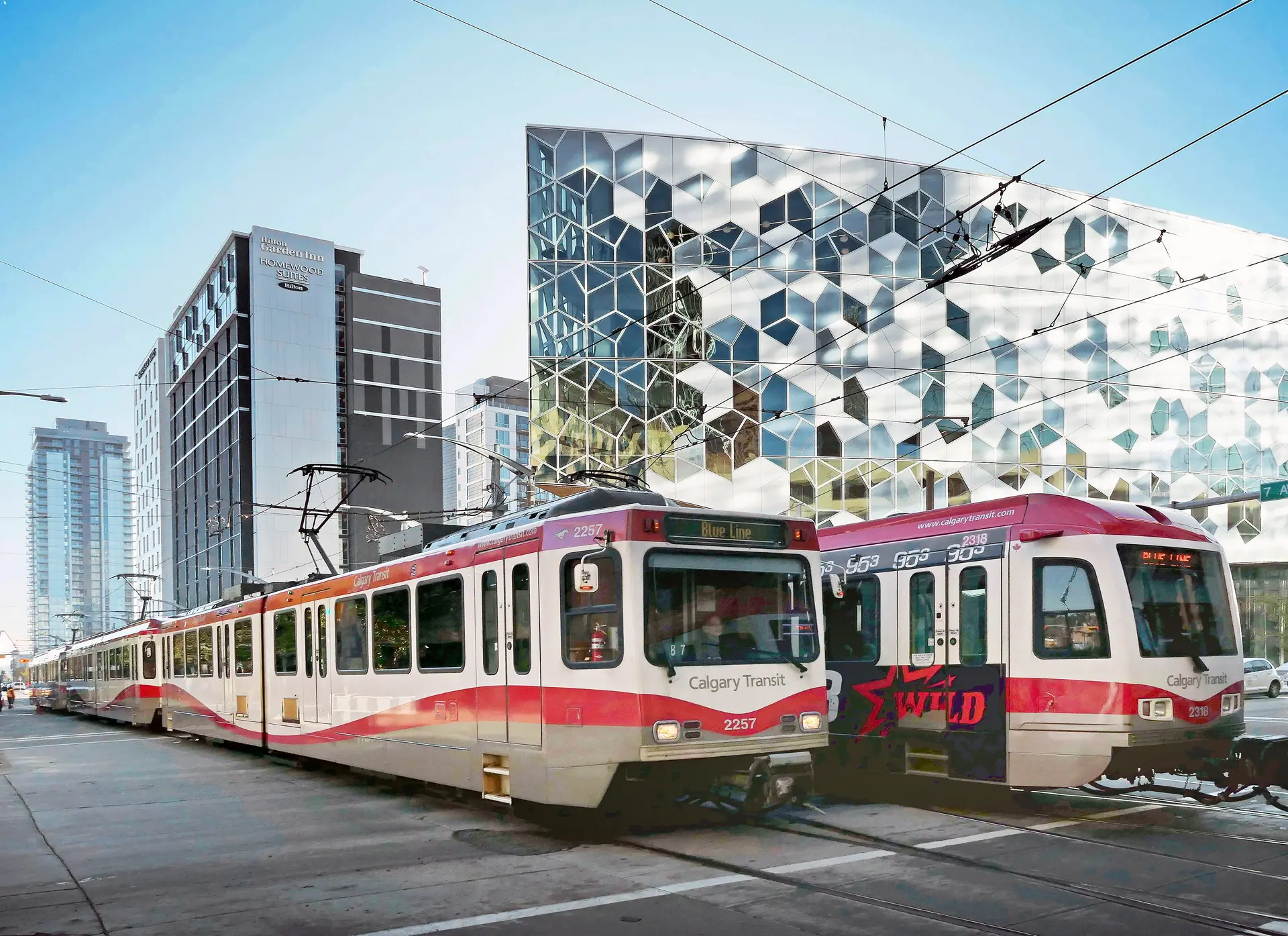
Calgary Transit runs two light-rail lines. The Red Line runs from the far northwest (Tuscany) through downtown to the deep south (Somerset–Bridlewood). The Blue Line runs from the northeast (Saddletowne) through downtown to the west (69 Street). Both share the same tracks along 7 Avenue through the core, which is why downtown stations are so easy to use: you can hop between lines without leaving the platform area.
Many maps also show the future Green Line to the southeast and north. It is under construction and not yet in service, so plan with what is running today.
Buses do the rest. The busiest corridors have MAX rapid-bus routes with dedicated lanes and fewer stops; regular routes feed the CTrain stations. Frequencies drop sharply in the evening and on weekends, so always check the trip planner before a late trip.
Fares, passes and the My Fare app
Fare categories matter in Calgary because they are generous to families. According to the Calgary Transit fares page (2026 rates, checked 2026-11-03):
| Who | Rule |
|---|---|
| Children 12 and under | Ride free |
| Youth 13–17 (and full-time high-school students to 21 with ID) | Reduced fare |
| Adults 18+ | Adult fare: $4.00 cash, valid 90 minutes; day pass $12.65; monthly pass $126.00 |
| Seniors 65+ | Annual pass ($169.00 regular; $34.00 low-income) |
| Low-income adults | Monthly pass priced on a sliding scale through the City’s Fair Entry program |
| Dogs on a leash | Free |
Prices change each January; use the fares page as the source of truth, not this table.
My Fare is the official mobile ticketing app. You buy single tickets, day passes or monthly passes on your phone, then activate the ticket and validate it at the scanner before boarding (on the bus, the lower screen of the validator; on the CTrain, the platform validator). A monthly pass only needs validating on its first trip; single tickets must be validated every trip. Unused tickets expire seven days after purchase. The app is English only.
The downtown Free Fare Zone
For decades the CTrain has been free along 7 Avenue downtown, between Downtown West/Kerby and City Hall/Bow Valley College stations. It is a genuine perk if you work downtown. In February 2026 Calgary Transit ran a public survey and announced that the zone’s future would be decided in an updated Fare Revenue Policy, so the rule may have changed by the time you read this. Check the Calgary Transit news page before boarding without a fare.
Accessibility
Calgary Transit states that every vehicle has a ramp, low-floor buses serve all 155 routes, and all 45 CTrain stations have elevators, ramps or ground-level access. Not every bus stop is accessible; you can call 403-262-1000 to check a specific stop. Mobility aids up to 122 cm long and 76.2 cm wide fit on buses. Calgary Transit Access is a shared-ride, door-to-door service for people who cannot use regular transit, and a free Travel Training program offers one-on-one sessions for seniors and people with disabilities who want to learn the system.
Driving in Calgary
Most Calgary households own at least one car, and if you settle in a newer suburb you will probably join them. The good news: parking is plentiful outside the core, the roads are wide, and the ring road (Stoney Trail) now loops the entire city. The less good news: a few corridors carry a disproportionate share of traffic, and winter changes everything.
The roads everyone talks about. Deerfoot Trail (Highway 2) runs north–south along the east side and is the city’s main artery; it slows every weekday morning and afternoon. Crowchild Trail and Glenmore Trail are the other two names you will hear in traffic reports, with Macleod Trail and 16 Avenue (the Trans-Canada) close behind. If your commute crosses one of them, test it at 8 a.m. before you sign a lease.
Rush hour is roughly 7–9 a.m. and 3:30–6 p.m. Calgary’s office day often starts early (oil and gas culture), so the morning peak begins earlier than in Montreal.
Road conditions. 511 Alberta (511.alberta.ca and the app) shows live road conditions, cameras, closures and weather alerts for provincial highways, including the Trans-Canada to Banff. For city streets, the City’s snow page (calgary.ca/snow) reports plowing progress and whether a snow route parking ban is in effect; during a ban you cannot park on signed snow routes until it is lifted, and the City says crews spend the first 36 hours after a snowfall on the busiest routes.
Exchanging your licence
If you are living in Alberta permanently, you must exchange your driver’s licence within 90 days of becoming a resident, even if you travel during that time. You do it in person at a registry agent, the private offices that handle licensing and registration on the province’s behalf (there is no SAAQ equivalent; registry agents are everywhere, including inside shopping centres).
Registering and insuring your car
Alberta.ca states that new residents must switch to an Alberta registration within 90 days of moving. Go to a registry agent with proof of ownership, proof of insurance that lists you by name, acceptable ID, your previous registration and an Alberta address. An out-of-province inspection is required for vehicles bought outside Alberta but within Canada; the registry agent issues an inspection request and tells you whether your situation is exempt. Insurance in Alberta is private (there is no public plan like the SAAQ’s), so shop before you move: insurers will ask for your driving record from your previous province.
Winter tires: Alberta versus Quebec
Alberta’s winter driving guidance recommends winter or snow tires because they grip far better than all-seasons in cold, snow and ice, and it lists a full vehicle emergency kit (blanket, shovel, booster cables, sand or kitty litter, candle and matches, food, flashlight). But there is no mandatory winter-tire period in Alberta. Quebec, by contrast, requires winter tires on all vehicles registered in the province from December 1 to March 15 inclusive. Calgary winters are drier than Montreal’s, and many streets are snow-packed rather than slushy, but the mountain highways and the sudden freeze after a chinook are exactly where winter tires earn their keep. Most experienced Calgary drivers use them from roughly November to April.
Parking
Calgary Parking is a division of the City. On-street paid parking uses the ParkPlus system: you enter your licence plate and the zone number at a kiosk, in the MyParking app, or online, and enforcement checks plates rather than tickets on dashboards. The app shows a map of rates and lets you extend a session remotely. In the inner city many streets have residential parking permits, which you apply for through Calgary Parking once you have an address in the zone. Downtown parkades are notoriously expensive on weekdays, which is one more argument for the CTrain if you work in the core.
Cycling, walking and the +15
Calgary surprises people on a bike. The City maintains about 1,000 km of regional pathways and 96 km of trails, separate from roads, plus 290 km of on-street bikeways and cycle tracks and the 138 km Rotary/Mattamy Greenway that loops the city. The Bow River pathway alone takes you from the northwest suburbs to Fish Creek in the south without crossing traffic. Rules: keep right, 20 km/h unless posted, signal when passing, and only pedal-assist e-bikes (no throttle-only) on the pathways. In winter the City clears about 400 km of paved pathway, usually within 24 hours of a snowfall, so year-round commuting by bike is realistic for the determined.
Downtown, the +15 is Calgary’s answer to Montreal’s underground city, except it is above ground: 86 enclosed bridges and more than 16 km of climate-controlled walkways on the second storey, linking office towers, the CORE shopping centre and Devonian Gardens. Posted hours are weekdays 6 a.m. to 9 p.m., weekends and holidays 9 a.m. to 7 p.m., closed December 25. When it is −25 °C you will understand why Calgarians love it.
Shared e-scooters and e-bikes operate seasonally (spring to autumn) in the inner city; the operators change, so look for the current apps when you arrive.
The airport (YYC)
Calgary International Airport is in the northeast, about 20 minutes from downtown outside rush hour. YYC lists these options: licensed taxis and sedans waiting outside the terminal at the arrivals level; ride apps (Uber, Lyft) with pick-up zones assigned by each provider; Calgary Transit buses to several parts of the city (YYC notes plainly that there is no LRT connection); more than a dozen car-rental companies just outside the terminal; and short-term, long-term and cellphone-waiting parking. Fares are not published on the YYC page; a metered taxi to downtown is typically the price of a modest dinner, and ride-app prices surge when flights land in bunches.
For transit, YYC’s public transit page lists two routes at the terminal: Route 500, an express bus between downtown and the airport via Centre Street with limited stops (it replaced the long-running Route 300 when Calgary Transit launched its 500-series express network in 2026), and Route 100, which connects the airport to Saddletowne station on the Blue Line and the North Pointe bus terminal. Stops are across the roadway from Door 2 (domestic) and Door 15 (international) at the arrivals level; ticket machines at the stops take debit, credit or cash, and the regular fare applies. Confirm the schedule in the trip planner before an early flight.
Your next steps
- Read our guide to seasons and winter before you buy tires or a parka.
- Sort the paperwork in the right order with banking, ID and paperwork, which puts the licence exchange on a timeline with your health card and SIN.
- Thinking about where to live based on commute? The neighbourhood explorer lists sectors and transit access, and our housing costs guide explains what “close to the CTrain” costs.
- Work through the newcomer journey checklist to keep the 90-day deadlines visible.
- Official sources: Calgary Transit, Alberta.ca registry pages and 511 Alberta are linked at the end of this page.
Questions people ask
Do I need a car in Calgary?
It depends on where you live and work. Along the CTrain lines and in inner-city neighbourhoods you can manage without one; in newer suburban communities most households drive. Many newcomers rent close to a CTrain station for the first year and decide later.
Can I use my Quebec driver's licence when I arrive?
Yes, for up to 90 days after you become a resident. After that you must exchange it at a registry agent. A Quebec licence is exchanged without a knowledge or road test, but you surrender it and it is not returned.
Is Calgary Transit free downtown?
The CTrain has been free along 7 Avenue downtown for decades (the Free Fare Zone). In 2026 Calgary Transit reviewed the zone as part of a new fare policy, so check its website for the current rule before you ride without a fare.
Are winter tires mandatory in Alberta?
No. Alberta recommends winter tires in its winter driving guidance, but there is no mandatory period like Quebec's December 1 to March 15 rule. Most Calgary drivers use them anyway, and insurers may offer discounts.
How do I get from the airport to downtown without a car?
Taxis, sedans and ride apps (Uber, Lyft) pick up at the arrivals level. Calgary Transit's Route 500 express runs between the terminal and downtown, and Route 100 connects to the Blue Line at Saddletowne. There is no train to the airport. See the YYC transportation pages for current pick-up zones and stops.
Can I bring my bike on the CTrain?
Yes, outside the busiest periods. Calgary Transit publishes bike rules on its website; the pathway network also lets you avoid traffic on most of the river routes.
Is there service in French on Calgary Transit?
Calgary Transit operates in English. The My Fare app and the trip planner are English only, which is one reason this guide walks through them in French as well.
Sources and official links
- Calgary Transit — Fares & passesEN
- Calgary Transit — My Fare appEN
- Calgary Transit — Reviewing the Free Fare Zone (February 2026)EN
- Calgary Transit — AccessibilityEN
- Alberta.ca — Exchange a licence from outside AlbertaEN
- Alberta.ca — Register a vehicleEN
- Alberta.ca — Winter driving tipsEN
- Québec.ca — Requirements for winter tiresFR/EN
- Calgary Parking (City of Calgary)EN
- City of Calgary — Pathways and trailsEN
- City of Calgary — Plus 15 networkEN
- 511 Alberta — Road conditionsEN
- YYC Calgary International Airport — TransportationEN
- YYC Calgary International Airport — Public transit (Routes 100 and 500)EN
- City of Calgary — Snow and ice controlEN
This page is general information, not legal, immigration, medical or financial advice. Always confirm details with the official source linked.
Keep reading

Calgary seasons, winter preparation and the outdoors
Read
Banking, ID and paperwork: your first weeks in Calgary
Read
Housing in Calgary: renting, buying and what it costs
Read