En bref· Quick answer
Calgary was francophone before it was Calgary. A Catholic mission founded by French-speaking Oblates moved to the Elbow River in 1875, the same year the Mounted Police arrived; the land around it, secured in 1883, became the Village of Rouleauville, incorporated by about 500 residents by 1899 and annexed by Calgary in 1907, when its French street names disappeared. The neighbourhood is Mission today, the Rouleau House still stands, and the francophone community that began there now counts tens of thousands of French speakers, its own school board, a provincial flag recognized as a Symbol of Distinction, and a century-old association.
- French-Catholic Oblate missionaries founded the Notre-Dame-de-la-Paix mission and moved it to a site on the Elbow River in 1875 (Heritage Inspires YYC, checked 2026-11-03).
- In 1883 Fathers Albert Lacombe and Hippolyte Leduc secured land for the Oblates intending a francophone Catholic settlement south of Calgary; the Rouleau House was built in 1885 and is the oldest surviving building in Mission (Calgary Heritage Initiative, checked 2026-11-03).
- Dr. Édouard-Hector Rouleau, born in L'Isle-Verte in 1843, joined his brother, magistrate Charles-Borromée Rouleau, in Calgary in 1887; the brothers' families formed the core of the French-speaking community and the area became Rouleauville, later Mission (Dictionary of Canadian Biography, checked 2026-11-03).
- By 1899 about 500 residents had incorporated the Village of Rouleauville; Calgary annexed it in 1907 (Heritage Inspires YYC; Global News, checked 2026-11-03).
- The Franco-Albertan flag, designed by Jean-Pierre Grenier, was unveiled at ACFA's congress on 6 March 1982 and recognized in June 2017 as Alberta's first Symbol of Distinction; March is Alberta Francophonie Month, proclaimed 1 March 2018 (acfa.ab.ca, alberta.ca, checked 2026-11-03).
- In the 2021 census, 86,180 people in the municipality of Calgary could have a conversation in French, the highest count of any Alberta municipality; 261,435 Albertans (6.2%) knew French and 88,010 had French as one of their mother tongues (Statistics Canada, checked 2026-11-03).
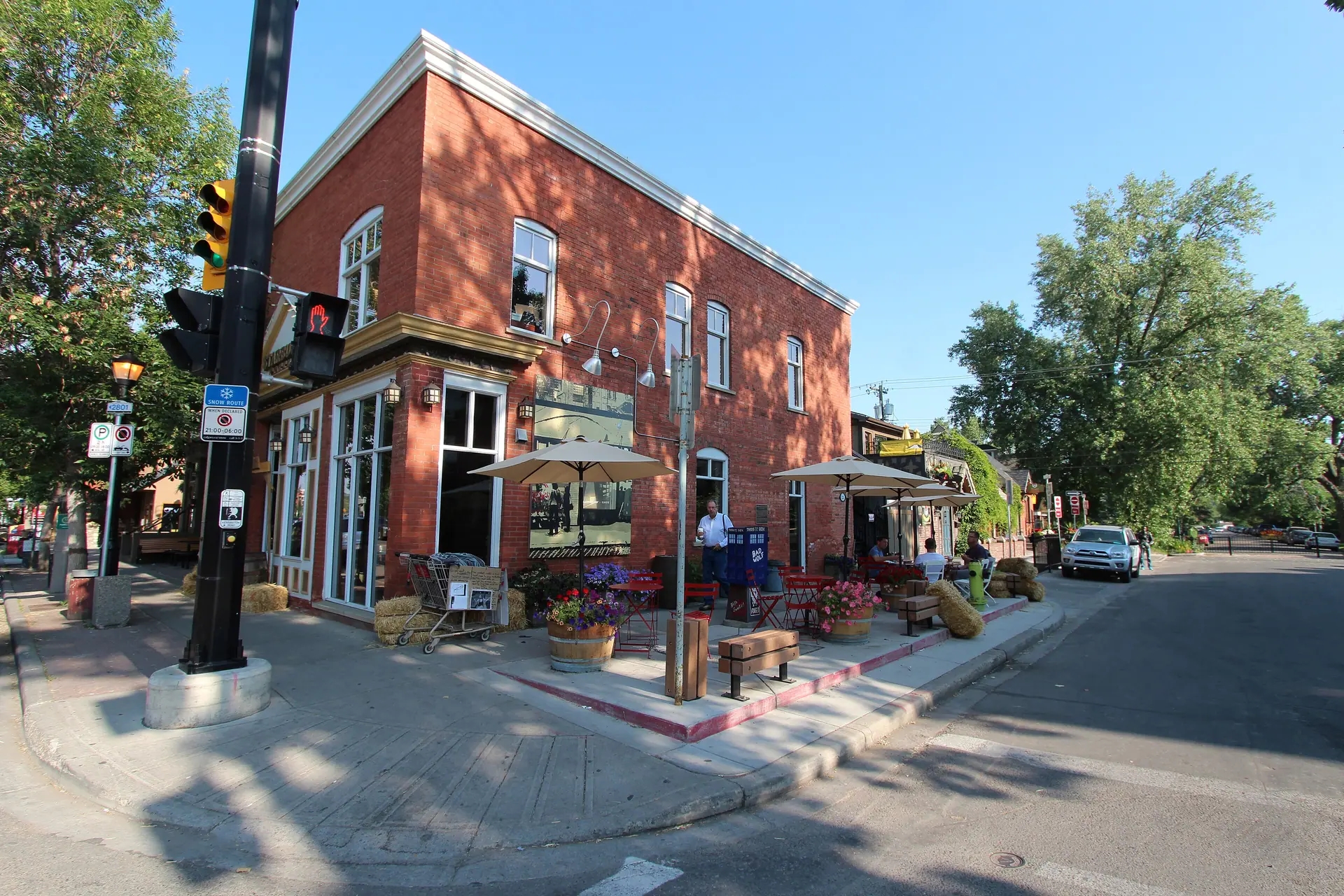
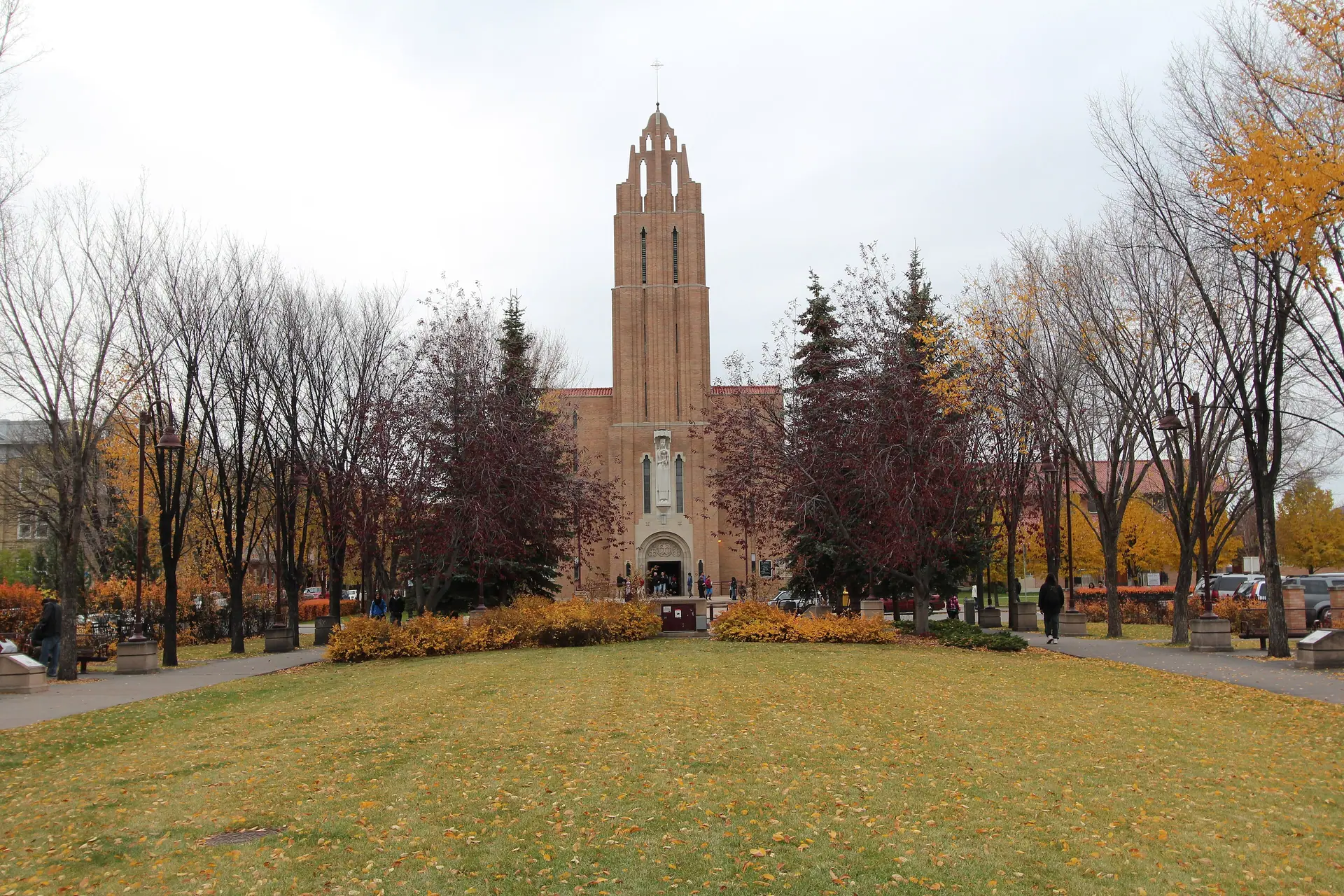
Walk south from 17th Avenue down 1 Street SW on a quiet morning and you pass, without any sign to tell you, through a village that no longer exists. The cathedral on your left, the small park in front of it, the Queen Anne house with the wraparound verandah beside the old railway station: these are what remain of Rouleauville, the French-speaking village that Calgary absorbed in 1907 and then mostly forgot. The neighbourhood is called Mission now. The name is the clue.
This is the francophone story of Calgary, told from sources you can check: the Dictionary of Canadian Biography, the City of Calgary, Calgary’s heritage organizations, ACFA’s own history, the Government of Alberta and Statistics Canada. Where the sources disagree on a date, we say so.
A mission before a city
Calgary’s French story begins with the Catholic missions. French-speaking Oblate missionaries founded the mission of Notre-Dame-de-la-Paix in the early 1870s and, in 1875, moved it to a site on the Elbow River, the same year the North-West Mounted Police built the fort at the junction of the Bow and the Elbow that would become Calgary. The mission came first; the police post followed within months; the town grew between them.
In 1883 the Oblates secured the land south of the new town for a francophone Catholic settlement; the Calgary Heritage Initiative credits Fathers Albert Lacombe and Hippolyte Leduc with the acquisition, and Heritage Inspires YYC records that Lacombe oversaw the subdivision of the Oblate mission townsite in 1884. Father Lacombe is a name you will meet across Alberta; in Calgary his name is on the mission lands where the city’s French quarter was laid out.
The Rouleau brothers
Two brothers from L’Isle-Verte, downstream from Québec City on the St. Lawrence, gave the village its name. Charles-Borromée Rouleau came to the North-West Territories as a magistrate. His younger brother Édouard-Hector, born in 1843, trained at the École normale Laval and the Séminaire de Nicolet, took his medical degree in 1870 and moved to Calgary in 1887 to join him in what the Dictionary of Canadian Biography calls “the tiny town of Calgary”. He practised medicine for the rest of his life, led the Holy Cross Hospital for a time, became assistant surgeon to the Mounted Police in 1897, served as Belgian consul for the Territories for fifteen years, and in 1888 was founding president of the local Société Saint-Jean-Baptiste. He died in Calgary in 1912.
The brothers and their families, the Dictionary records, formed the nucleus of Calgary’s French-speaking community, and the area south of 17th Avenue and east of 4th Street became known as Rouleauville.
Convent, hospital, village
The institutions that make a community came quickly. In 1885 the Faithful Companions of Jesus founded the Sacred Heart Convent, the first francophone Catholic school in southern Alberta. In 1892 the Grey Nuns founded the Holy Cross Hospital, which would serve Calgary for a century. By 1899, according to Heritage Inspires YYC, about 500 residents had incorporated the Village of Rouleauville, with its own streets named in French.
Then Calgary grew. In 1907 the city annexed Rouleauville; the French street names gave way to Calgary’s numbered grid and the village became a district of a fast-expanding anglophone city. St. Mary’s Parish Hall, built in 1905 to serve Rouleauville, became a Canadian Northern Railway station for sixty years and, since 1982, the home of Alberta Ballet. The park in front of St. Mary’s Cathedral, 0.2 hectares at 197 17 Avenue SW, is Rouleauville Square, named by the City for Charles and Edward Rouleau.
A province organizes: ACFA and the long fight for schools
Calgary’s francophones were part of a scattered Franco-Albertan population that organized itself in the 1920s. The Association canadienne-française de l’Alberta held the first meeting of its provisional committee at St-Joachim on 19 January 1926, electing Dr. Joseph-Étienne Amyot its first president; the ACFA marks 2026 as its centenary.
Its history, as the ACFA tells it, is largely the history of French schooling in Alberta: an amendment in 1968 allowing French instruction in other subjects for up to half the school day; the recognition, under section 23 of the Canadian Charter of Rights and Freedoms in 1982, of minority-language educational rights for citizens whose first language learned and still understood is that of the linguistic minority; and, in the early 1990s, Alberta’s Bill 8 giving francophones control of their own school governance. From that came the francophone school boards; in Calgary and the south of the province, Conseil scolaire FrancoSud, headquartered in the city, today runs 19 public and Catholic French first-language schools for about 4,400 students, with more in preparation. The provincial Francophone Secretariat was created in 1998 and 1999 at the ACFA’s request, and the Franco-Albertan flag flew for the first time at the Legislature in the same period.
The flag
The flag that hangs in francophone schools and rises in front of Calgary City Hall each March was the idea of Alberta’s francophone youth: Francophonie jeunesse de l’Alberta ran a contest for an emblem, and the winning design by Jean-Pierre Grenier was unveiled at ACFA’s annual congress on 6 March 1982. Blue stands for the Albertan population, white for the francophone community; where the two colours meet along the diagonal, the flag says that the francophonie is an important part of Alberta’s community. The province describes it as blue, white and rose, and in June 2017 adopted it as Alberta’s first Symbol of Distinction under the Emblems of Alberta Act. On 1 March 2018 the Government of Alberta proclaimed March the annual Mois de la francophonie albertaine.
Alberta’s own heritage page adds the oldest fact of all: French, it says, was the first European language spoken in Alberta, carried by the fur traders who preceded the missions.
French in Calgary now
The community that began with two families from L’Isle-Verte is now one of the largest French-speaking populations in western Canada. Statistics Canada’s key facts for 2021 report that 261,435 Albertans, 6.2% of the population, could have a conversation in French; 88,010 had French as one of their mother tongues; 64,440 had French as their only first official language spoken, with another 15,525 reporting French and English. Among municipalities, Calgary had the highest number of people who knew French, 86,180, ahead of Edmonton’s 67,240; the Calgary census metropolitan area counted 98,455.
Those are different measures of different things, and we quote them with their labels on purpose: “knowledge of French” counts everyone who can hold a conversation, including immersion graduates and newcomers from Senegal and Lyon alike; “mother tongue” and “first official language spoken” are narrower. What all of them show is the same shape: a francophonie that is growing, urban and increasingly born outside Canada.
Which is why, in March 2019, the federal government named Calgary one of the first Welcoming Francophone Communities, and why a French-language newspaper founded in 1928, Le Franco, still reports on it. The village was annexed; the community was not.
Your next steps
- Visit Mission: Rouleauville Square at 197 17 Avenue SW, the Rouleau House at 1880 1 Street SW, St. Mary’s Parish Hall beside it. Our neighbourhood explorer has the community profile.
- Meet the institutions that carry the story forward in the directory: ACFA régionale de Calgary, FrancoSud, La Cité des Rocheuses and the others.
- Look for flag raisings and the Francophonie month events each March on the events calendar.
- Read ACFA’s own Historique and Statistics Canada’s key facts on French in Alberta for the full record.
Questions people ask
Where was Rouleauville?
South of 17th Avenue SW and east of 4th Street SW, on the Oblate mission lands by the Elbow River. It is the neighbourhood of Mission today; Rouleauville Square, the small park in front of St. Mary's Cathedral at 197 17 Avenue SW, carries the name.
Who were the Rouleau brothers?
Charles-Borromée Rouleau, a magistrate, and his brother Édouard-Hector Rouleau, a physician born in L'Isle-Verte, Lower Canada, in 1843, who joined him in Calgary in 1887, practised medicine, led the Holy Cross Hospital for a time and became assistant surgeon to the North-West Mounted Police in 1897. Their families formed the core of Calgary's French-speaking community.
Can I visit the Rouleau House?
You can see it. Built in 1885, moved more than once and restored in 2019 and 2020, it stands at 1880 1 Street SW beside St. Mary's Parish Hall and is the home of ACFA régionale de Calgary. It was designated a municipal historic resource in September 2020.
What does the Franco-Albertan flag mean?
Blue for the Albertan population, white for the francophone community, meeting along a diagonal to say that the francophonie is an important part of Alberta. Designed by Jean-Pierre Grenier, unveiled 6 March 1982, and Alberta's first Symbol of Distinction since June 2017.
How many francophones live in Calgary?
It depends on the measure. Statistics Canada's 2021 census found 86,180 people in the municipality of Calgary who could have a conversation in French, the highest of any Alberta municipality; the figure for the Calgary census metropolitan area was 98,455. Province-wide, 88,010 Albertans reported French as one of their mother tongues.
Sources and official links
- Dictionary of Canadian Biography — Rouleau, Édouard-HectorFR/EN
- Heritage Inspires YYC — Communities: MissionEN
- Calgary Heritage Initiative — Rouleau House: restoration revealedEN
- City of Calgary — Rouleauville SquareEN
- Global News — 2 Calgary buildings with francophone settler connection given historic designation (14 Sept. 2020)EN
- ACFA — HistoriqueFR
- ACFA — Symboles (the Franco-Albertan flag)FR
- ACFA régionale de CalgaryFR
- Alberta — Francophone heritage in AlbertaEN
- Statistics Canada — Key facts on the French language in Alberta in 2021FR/EN
- Constitution Acts 1867 to 1982 — section 23, Minority Language Educational RightsFR/EN
- Conseil scolaire FrancoSudFR
- Le FrancoFR
- IRCC — Calgary selected as a Welcoming Francophone Community (2019)EN