En bref· Quick answer
Moving from Quebec to Calgary is a move inside the same country that feels, in a dozen small ways, like crossing a border. Sales tax drops from 14.975% to 5%. The notaire disappears and a lawyer appears. Auto insurance is bought from a private insurer. Driver's licences come from a registry agent, not the SAAQ. The weather swings 20 degrees in an afternoon. The sky is enormous, the roads are wide, nobody moves on July 1, and everybody says Hi. This explainer lists what surprises people from Quebec, with the official source for each.
- Alberta charges 5% GST and no provincial sales tax; Quebec charges 5% GST plus 9.975% QST (Canada Revenue Agency rate table, checked 2026-11-03).
- In Alberta, basic auto insurance is mandatory and sold by licensed insurers; in Quebec, the SAAQ handles licences, registration and bodily-injury coverage (Alberta.ca; SAAQ, checked 2026-11-03).
- Registry agents, private offices licensed by the province, handle Alberta driver's licences, vehicle registration, AHCIP health card applications and land titles searches (Alberta.ca, checked 2026-11-03).
- Chinooks are warm, dry winds descending the east side of the Rockies; Environment and Climate Change Canada's glossary explains the mechanism (Canada.ca, checked 2026-11-03).
- The Calgary Stampede's next edition runs July 9 to 18, 2027 (Calgary Stampede, checked 2026-11-03).
Every Quebecer who moves to Calgary collects the same list. It starts at the airport, grows at the first grocery till, peaks the first time a January afternoon hits plus twelve, and settles into fond exasperation somewhere around the first Stampede. Here is the list, with sources, so that you can argue about it with people back home.
1. The till is kinder: 5% instead of 14.975%
The first receipt is the first shock. Alberta charges the 5% federal GST and no provincial sales tax at all. Quebec charges 5% GST plus 9.975% QST. The Canada Revenue Agency’s rate table lays it out province by province. Prices are still posted before tax, as everywhere in Canada, so the pleasant surprise happens at the register.
2. No notaire. A lawyer.
In Quebec, buying a home means a notary: the notaire checks the title, drafts and witnesses the deed of sale, registers it in the land register, pays off the seller’s creditors, and is mandatory for the mortgage deed, as Éducaloi explains. In Alberta, there is no notaire in that sense. Property transfers are registered by the provincial Land Titles Office, and in practice each party retains a lawyer for the closing, the title search and the registration. The Real Estate Council of Alberta’s consumer hub explains the buying process and how to check that an agent is licensed. Our buying a home in Alberta guide goes step by step.
3. Auto insurance from a private insurer
Quebec drivers are used to the SAAQ, the public body that handles driver’s licences, registration, bodily-injury coverage and road safety, with private insurers covering the car itself. In Alberta, basic automobile insurance, meaning accident benefits and third-party liability, is required by law and sold by licensed insurers, with rates overseen by a provincial rate board; collision and comprehensive coverage are optional add-ons. Shop early: insurers price Quebec driving history differently, and you will need proof of insurance to register a car.
4. The registry agent, not the SAAQ counter
Alberta has no government counter for licences and plates. Instead, registry agents, private offices licensed by the province, provide driver licensing, vehicle registration, land titles searches and other government services. They also take your application for the Alberta Health Care Insurance Plan (AHCIP), the equivalent of RAMQ, free of charge. There are dozens in Calgary, often in strip malls, often open evenings and weekends. Quebecers find this either delightful or unsettling, sometimes both in the same visit.
5. Chinooks: winter takes the afternoon off
A chinook is a warm, dry wind that descends the eastern slopes of the Rockies. Environment and Climate Change Canada’s glossary describes the mechanism: moist air rises over the mountains and drops its precipitation on the windward side, then warms as it descends the lee side. The effect in Calgary is a wall of cloud in the west, a sudden wind, and a temperature that can climb by twenty degrees in hours. Snow becomes puddles, puddles become ice overnight, and some people get headaches. It is the single most Calgarian thing about Calgary. Nobody in Montreal will believe you.
6. The sun
Calgary is dry and high, and its winters are sunnier than Quebec’s grey ones. Environment and Climate Change Canada’s climate normals for the Calgary airport are the place to compare hours of bright sunshine with your home city. The practical consequences: sunglasses in January, moisturizer always, and a winter that is cold but rarely dreary.
7. The mountains are an hour away, and they are real
Quebec has hills. Calgary has the Rocky Mountains, visible from most of the west side of the city on a clear day and about an hour’s drive away. Skiing, hiking and the national parks are a weekend habit here, not a holiday. The seasons and winter guide covers how Calgarians use them.
8. The grid and the quadrants
Calgary addresses end in NW, NE, SW or SE. The City’s addressing page lists those four quadrant qualifiers as part of every standard address. Centre Street divides east from west and the Bow River, roughly, divides north from south; numbered streets run north–south and numbered avenues east–west, with numbers growing as you move away from the centre. Once it clicks, you can locate “1200 Something Street SW” without a map. Until it clicks, 4th Street SW and 4th Street NE are twenty minutes apart and you will confuse them exactly once.
9. Wide roads, big trucks, no potholes to speak of
Calgary’s roads are wide, the speed limits are posted in the same units, and the ratio of pickup trucks to cars is a genuine cultural shift. The Deerfoot Trail is the city’s north–south freeway and its most-complained-about road. Drivers are, on average, more patient than in Montreal. You will adjust in both directions.
10. Gas prices
Alberta gas is usually cheaper than Quebec’s, partly because of the tax difference above. Rather than quote a number that will be wrong by the time you read it, we point you to Natural Resources Canada’s weekly retail fuel price comparison by city.
11. The Stampede
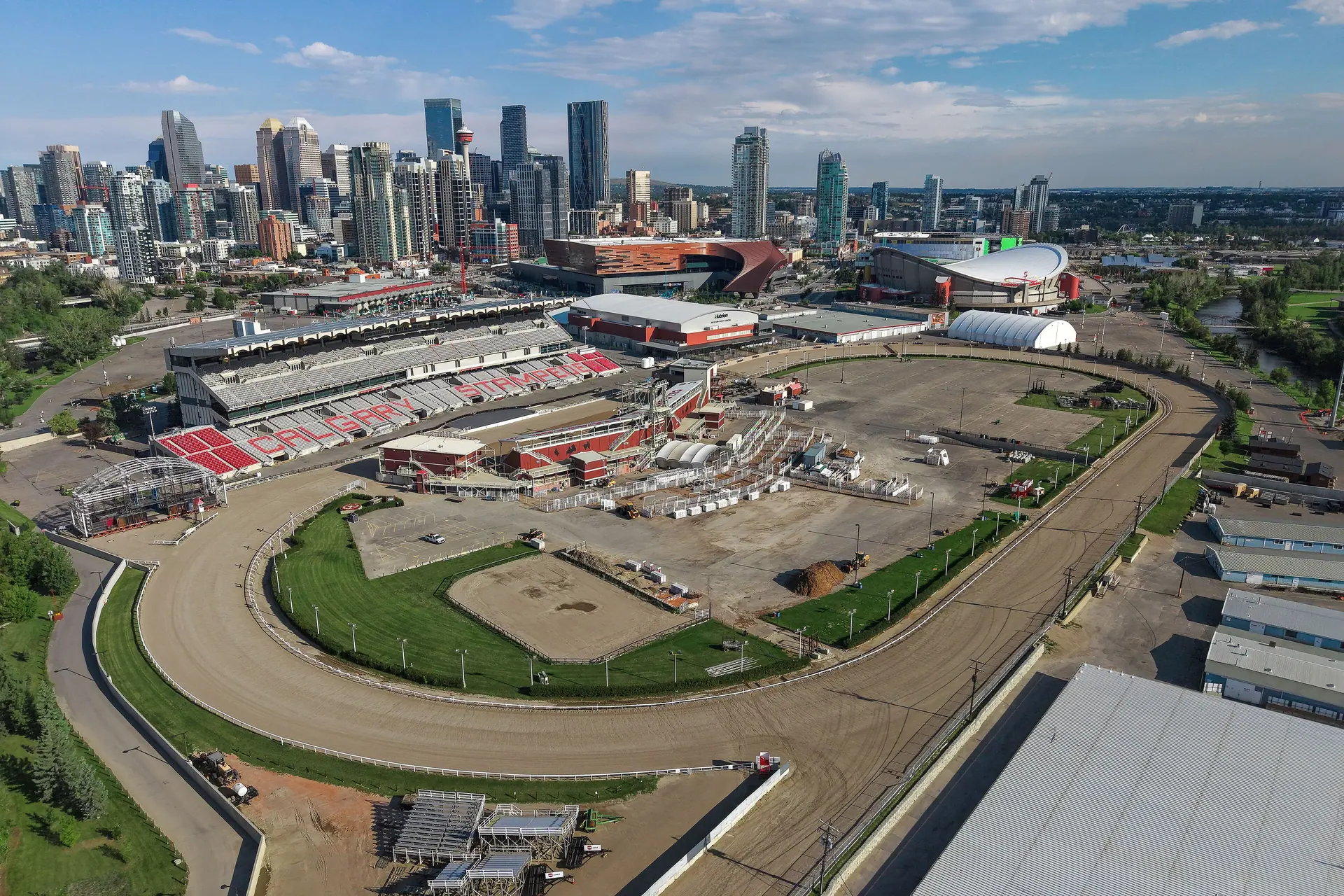
For ten days each July, the city puts on a cowboy hat. The Calgary Stampede is a rodeo, a fair, a concert series and a civic festival rolled together; the next edition runs July 9 to 18, 2027. Offices host pancake breakfasts, downtown empties at noon, and newcomers discover that “western wear” is a dress code. Rodeo has its critics and its defenders; the organization publishes its animal-care rules on its site, and you can take part in the festival side without the rodeo side. Quebecers tend to go once ironically and the second time sincerely.
12. Nobody moves on July 1
In Quebec, July 1 is moving day, the day most leases end and the Tribunal administratif du logement staffs a hotline for the chaos. In Alberta, leases start and end whenever the parties agree, and July 1 is simply Canada Day. Moving trucks are available year-round, and your landlord will not expect you out by noon on a holiday. Our renting in Calgary guide explains Alberta’s tenancy rules.
13. “Hi”
The greeting in a Calgary shop is “Hi, how’s it going?”, and the expected answer is “Good, you?” There is no Bonjour-Hi. Service in French exists in francophone organizations, some government offices and the businesses in our directory, and nowhere else by default. The good news: Calgarians are patient with accents, and “sorry, English is my second language” produces a slower, friendlier conversation almost every time.
14. A different political culture
Alberta’s politics are not Quebec’s, and the conversation around them, in the news, at the rink and at family dinners, has its own assumptions. We keep this site non-partisan and will leave it there, except to say that you will be asked where you stand on pipelines within a month, and “I just got here” is an acceptable answer.
15. Tipping and the rest of the till
Tipping customs are similar to Quebec’s: restaurants, taxis, hairdressers, and increasingly the payment terminal at the counter. Nothing to relearn, except that the pre-tax price is smaller and the tip suggestions are calculated on it.
16. Magpies, jackrabbits, and the occasional deer on your lawn
Black-billed magpies are everywhere in Calgary: loud, clever, black and white with an iridescent tail. The City’s wildlife page notes they eat nuts, seeds, insects and small animals and are well adapted to the urban environment. White-tailed jackrabbits, which turn white in winter, lope through residential streets at dusk. Deer, coyotes and the occasional bobcat appear in river valleys and suburbs. This site’s mascot, Pica, is a magpie for a reason.
17. Smoke season
Some summers bring wildfire smoke from fires in British Columbia, northern Alberta or beyond, and the sky turns orange for days. Alberta publishes the Air Quality Health Index, a 1-to-10 scale that relates outdoor air quality to health risk, and issues air quality statements when smoke arrives. People with asthma or heart conditions, children and older adults are advised to limit outdoor exertion on bad days. It is not every summer, and it is not every week of a bad summer, but it is part of the calendar now.
18. Being a minority
This is the deep one. In Quebec, French is the air. In Calgary, French is a choice you make every day: the school you pick, the events you attend, the radio station, the friends. Some Quebecers find that exhausting; many find it clarifying, and discover a francophonie that is more varied than the one they left, with Franco-Albertans, Acadians, Africans, Europeans, Haitians, Lebanese and Vietnamese francophones sharing the same cultural centre. The ACFA régionale de Calgary has served the community since 1983 from the Maison Rouleau; it is a good first visit. Our finding community explainer is the longer answer.
Your next steps
- Read the full moving from Quebec to Calgary guide, and the from Montreal and from Quebec City companions.
- Start the new to Calgary checklist with the Quebec version selected.
- Find a registry agent, the AHCIP form and the licence exchange rules on Alberta.ca.
- Browse events in French and the directory.
- Practise the “Hi, how’s it going?” exchange in the learning section, in the English-for-French-speakers lessons.
Questions people ask
Do I really pay no sales tax in Alberta?
You pay the 5% federal GST and no provincial sales tax. The Canada Revenue Agency's rate table shows Alberta at 5% GST with 0% PST, against Quebec's 5% GST plus 9.975% QST. Prices on shelves are still shown before tax, so the surprise comes at the till, in the pleasant direction.
Who replaces the notaire when I buy a house?
A lawyer. Alberta's Land Titles Office registers transfers, and in practice a lawyer handles the closing, the title search and the registration for each side. The Real Estate Council of Alberta's consumer hub explains the buying process and how to check your agent's licence.
Is my Quebec driver's licence valid?
For a limited period after you move, after which you exchange it at an Alberta registry agent. The rules, timelines and documents are on Alberta.ca; our moving from Quebec guide walks through them step by step.
Is the winter worse than Montreal's?
Different. Calgary is drier, sunnier and windier, with less snow on the ground for long stretches and sudden chinook thaws, then sudden cold. The thing nobody warns you about is the sun: you will want sunglasses in January.
Will I be able to live in French?
Partly, and more than most people expect, if you go looking. Francophone schools, a cultural centre, an Alliance Française, Radio-Canada, French-speaking professionals and events exist. Daily life in shops and offices is in English. This site exists to shorten the search.
Sources and official links
- Canada Revenue Agency — GST/HST calculator and rates by provinceFR/EN
- Éducaloi — Immobilier : le rôle du notaireFR
- Alberta.ca — Land titles overviewEN
- RECA — Buying a home (consumer hub)EN
- Alberta.ca — Automobile insuranceEN
- SAAQ — Société de l'assurance automobile du QuébecFR
- Alberta.ca — Registry agentsEN
- Alberta.ca — How to apply for AHCIPEN
- Environment and Climate Change Canada — Weather and meteorology glossary (Chinook)FR/EN
- Environment and Climate Change Canada — Canadian Climate NormalsFR/EN
- City of Calgary — Addressing (quadrant qualifiers)EN
- Calgary StampedeEN
- Québec.ca — Déménagements du 1er juillet : le Tribunal administratif du logement au bout du filFR
- Natural Resources Canada — Transportation fuel pricesFR/EN
- Alberta.ca — Air Quality Health IndexEN
- City of Calgary — Wild animals in Calgary's natural areasEN
- ACFA régionale de CalgaryFR