En bref· Quick answer
A Calgary winter is colder than you fear and sunnier than you expect. It runs roughly November to March, broken every few weeks by chinook winds that can turn a frozen week into a wet, mild afternoon. The things that matter are not the ones newcomers plan for: dry air more than cold, light more than snow, a block heater more than winter tires, and a reason to go outside more than a reason to stay in. This is the season, in order, as it happens.
- Calgary's official forecasts and warnings come from Environment and Climate Change Canada; its Canadian Climate Normals database holds the long-term averages for the Calgary International Airport station (weather.gc.ca, checked 2026-11-03).
- Property owners in Calgary must clear the sidewalk bordering their property within 24 hours after a snowfall ends (calgary.ca, checked 2026-11-03).
- The City's Snow Angels program recognizes residents who shovel for a neighbour, especially older adults and people with limited mobility (calgary.ca, checked 2026-11-03).
- Alberta does not have Quebec's mandatory winter-tire period; the province still advises winter tires and an emergency kit for winter driving (alberta.ca, saaq.gouv.qc.ca, checked 2026-11-03).
- 511 Alberta shows live highway conditions; Alberta Health Services lists 24-hour help lines, and 9-8-8 is the bilingual crisis line (511.alberta.ca, ahs.ca, 988.ca, checked 2026-11-03).
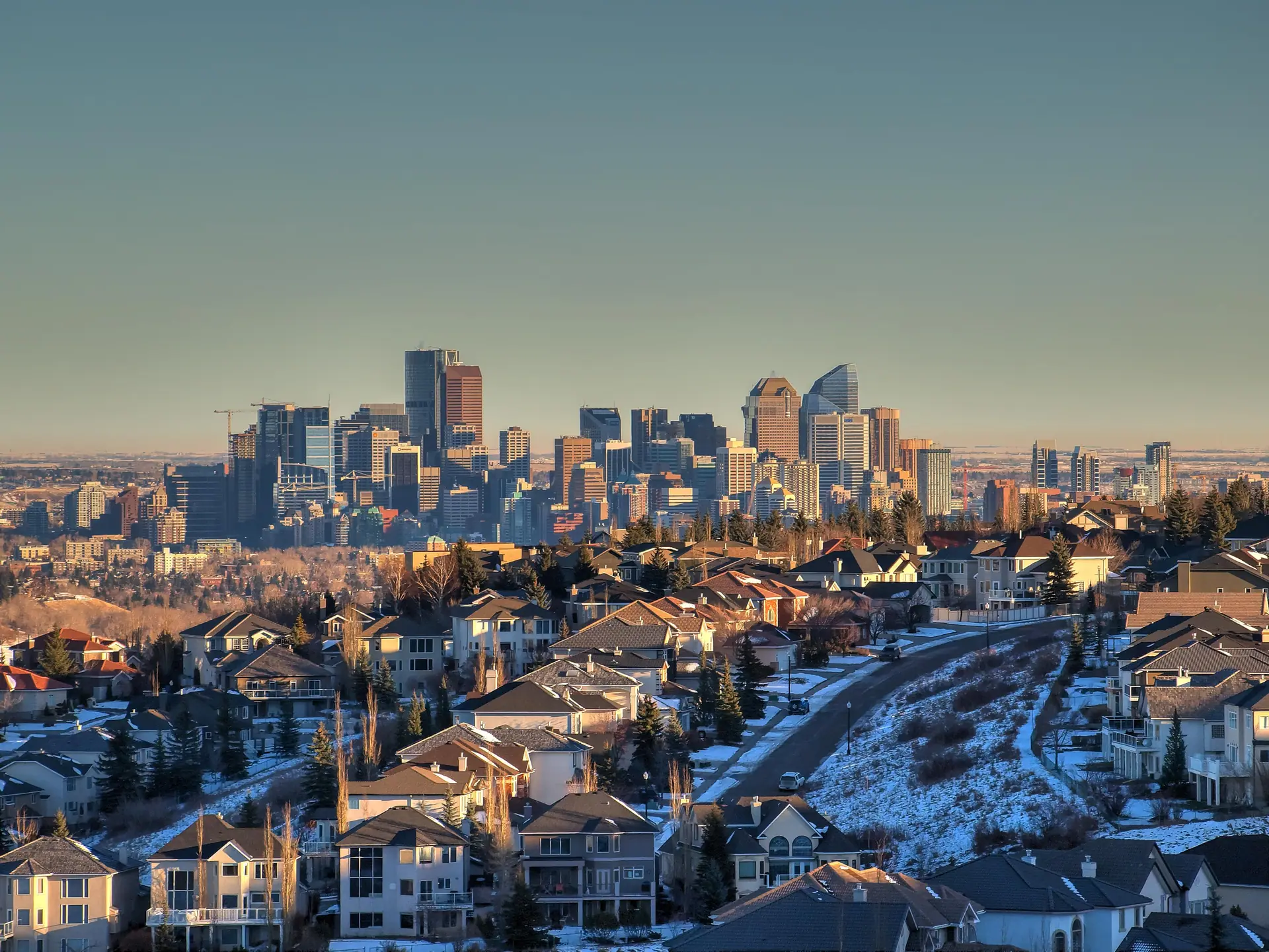
The first thing nobody tells you is that it will be sunny. You will stand in your kitchen on a January morning, the thermometer saying -27, the sky a hard flawless blue, and the light so bright on the snow you will reach for sunglasses before your coat. Calgary’s winter is not the grey wet dark of Paris or the slush-and-sleet of a Montréal thaw. It is high, dry, cold and lit like a stage. Once you understand that, you understand the whole season.
This is a walk through a first winter in the order it tends to happen, written for people who have never done one. It is general and personal rather than statistical: for the averages, the Environment and Climate Change Canada Climate Normals database holds the long-term record for the Calgary International Airport station, and the Environment Canada forecast page is the one Calgarians check every morning.
October: the rehearsal
Calgary’s first snow usually comes in October, sometimes earlier, and it almost always melts within days. Treat it as a dress rehearsal. This is when you find out whether your coat is a coat or a jacket, whether your boots grip on packed snow, and whether your car has a block heater cord (look for a short plug hanging behind the grille or tucked into the bumper). It is also the month to book a tire change; shops fill up the week of the first real storm.
Two shopping notes. First, the words: Canadians say tuque (toque) for the warm hat, mitts for mittens, and parka for the long insulated coat you actually want. Second, the gear worth spending on is boots and gloves. Cold hands and feet are what send people indoors; a cheaper coat over good layers works fine.
November: it gets real
Somewhere in November the ground freezes and stays frozen. Days get short fast: the sun is setting before five, and by the solstice it sets around half past four. The dark is the adjustment most people underestimate. Calgary’s answer is the light itself: those blue-sky days are the compensation, and newcomers who learn to go outside at noon, even for ten minutes, do better than the ones who wait for warmth.
The air is dry. Not pleasantly dry; aggressively dry. Lips crack, skin itches, and you wake up at three in the morning with a throat like paper. Buy a humidifier for the bedroom, keep a lip balm in every pocket, and drink water as if it were summer. Static electricity becomes a daily event; you will learn to touch a doorframe before a light switch.
The chinook
Every few weeks, often with no warning, the western sky shows a long clean arch of cloud over the mountains, the wind swings around to the southwest, and within hours the temperature can rise fifteen degrees or more. Snowbanks shrink before your eyes; the sidewalks run with water; people stand outside in T-shirts in January because they can. This is the chinook, the warm dry wind off the Rockies, and it is the thing that makes Calgary’s winter unlike any other in Canada.
Chinooks are a mixed gift. They melt the snow and lift the mood, and then everything refreezes overnight into a sheet of ice. Some people get headaches from the pressure change. Skating rinks and cross-country trails suffer. But for a newcomer, the chinook is the reason a Calgary winter is survivable: it is never five months of unbroken cold.
The first -30 morning
It will come, usually in a stretch of a few days, often in January or February, and sometimes in a polar vortex that the whole country complains about together. What -30 feels like: your nose hairs freeze on the first breath, the snow squeaks under your boots instead of crunching, and exposed skin starts to hurt within minutes. Environment Canada issues extreme cold warnings; take them literally about exposed skin and about children, who lose heat faster.
The practical list for that week. Plug in the car overnight. Keep the gas tank above half. Carry an emergency kit (the province’s winter highway page lists one: blanket, first-aid kit, booster cables, and so on). Warm the car for a few minutes but not twenty; the engine does not need it and your neighbours do not want it. Dress children in layers, with a scarf or balaclava over the face for the walk to school, and do not be surprised when the school keeps them indoors at recess. Then make soup. That is the rule.
How Calgarians dress
Layers, and the right ones. A thin base layer (merino or synthetic, never cotton against the skin), a warm middle layer (fleece or a down vest), and a wind-proof outer shell or parka. Wool socks. Boots rated well below zero with real tread. Mitts over gloves when it is truly cold, because fingers together stay warmer than fingers apart. A tuque that covers the ears. Sunglasses, because of that light.
What you will notice: Calgarians underdress for short dashes (car to office, car to store) and dress properly for anything longer. Nobody wears a parka indoors; buildings are kept warm and a coat check or a hook by the door is part of every visit. And the city dresses for function first: the person in the puffy coat and ski pants at the grocery store is not going skiing, they are just comfortable.
What to do on a -25 Saturday
Go outside. This is the whole trick, and the one newcomers resist longest. On a bright cold Saturday, Calgarians skate on outdoor rinks and lagoons, walk or cross-country ski the river pathways, toboggan the hills in the big parks, and drive an hour west to the mountains where the snow is deep and the cafés are warm. The pattern is short bursts outside, long warm-ups inside, repeat. Hot chocolate is not a cliché here; it is infrastructure.
If the cold is too much that day, the city has an indoor life built for winter: public libraries (free membership, warm, full of programs, including French conversation practice), recreation centres with pools and tracks, the +15 skywalk system that links downtown office towers above the street, museums, and a surprising number of greenhouses and indoor gardens. Our libraries, recreation and free activities guide lists the public options with their sources.
Snow, sidewalks and neighbours
The City clears major roads first and residential streets later, sometimes much later, so a side street can stay snow-packed for weeks; you drive on it, slowly. Sidewalks are different: property owners must clear the sidewalk bordering their property within 24 hours after a snowfall ends, and the City enforces it on complaint. Buy a good shovel in October, not in the storm.
That bylaw produced one of the city’s nicest traditions. The Snow Angels program recognizes people who shovel for a neighbour who cannot, especially older adults and people with limited mobility. Shovelling an extra sidewalk is also, quietly, the fastest way to meet the people on your street.
Light, mood and the long middle
February is the long middle. The novelty is gone, the snow is old, and the days are only slowly lengthening. This is when the dark catches up with people, especially those who arrived from somewhere warm and bright. Some practical things help: morning light, outdoor time at noon, vitamin D if your doctor suggests it, exercise, and company. Francophone organizations run winter programming precisely because February needs it; the events calendar shows what is on.
If it is more than a low mood, say so. Alberta Health Services keeps a page of 24-hour help lines, including a mental health help line, and 9-8-8 is the national suicide crisis line by call or text, in French and English. Moving countries and seasons at the same time is a heavy lift, and asking for help is what Calgarians do too.
Kids and snow days
Calgary schools rarely close for weather; they are built for it, and buses run in almost anything. What changes is recess: on extreme-cold days children stay inside, and the rest of the time they go out, so the school will ask for snow pants, boots, mitts and a tuque every day from November to March, labelled. Francophone schools and daycares will tell you exactly what to pack. Children adapt faster than parents; by the second winter yours will be the ones dragging you to the toboggan hill.
March: the turn
Then one day in March the sun has weight again. The snow goes grey and granular, the pathways reappear, the first crocuses push through on south-facing slopes, and the magpies, who never left, get loud. It is not spring; Calgary will snow again in April and sometimes in May, and the locals will shrug. But the light is back, the days are long, and the mountains are still full of snow for skiing on a warm afternoon. March is also Alberta Francophonie Month, proclaimed by the province, with flag raisings and festivals across the city, which is a fitting time to look up from the shovel and find that you have, somehow, done a Calgary winter.
Your next steps
- Read the practical list in the seasons and winter guide, including clothing, driving and the City’s expectations.
- Bookmark the Environment Canada forecast and 511 Alberta before any mountain drive.
- Find winter programming in French on the events calendar.
- If you have not yet, work through the New to Calgary checklist; winter preparation is one of its stages.
Questions people ask
How cold does it really get?
Cold enough that -20 is an ordinary January week and -30 happens most winters, usually in short stretches. The surprise is how often it is not cold: chinook winds push temperatures above freezing many times each winter. For the long-term averages, look up the Calgary International Airport station in Environment Canada's Climate Normals database; for tomorrow, use the Environment Canada forecast.
What is a chinook?
A warm, dry wind that comes down off the Rockies and can raise Calgary's temperature by ten or fifteen degrees in hours, often announced by a long arch of cloud over the western sky. It melts snow, cheers people up and gives some of them headaches.
Do I need winter tires?
Alberta does not require them, unlike Quebec's mandatory period, but the province recommends them and so does everyone who has driven Deerfoot Trail in January. Budget for them if you drive.
What is a block heater and do I need one?
An electric heater that keeps your engine warm overnight; you plug the car into an outlet with the cord that hangs from the grille. Most cars sold in Alberta have one. Below about -15, plugging in makes cold starts easier and kinder to the engine.
Is there anything to do outside at -25?
Yes, and that is the secret. Skating, cross-country skiing in the city, tobogganing, walking the river paths in the sun, hot drinks after. The Rockies are an hour away. Calgarians go out in winter; they just dress for it.
Sources and official links
- Environment and Climate Change Canada — Calgary 7-day forecastFR/EN
- Environment and Climate Change Canada — Canadian Climate Normals (search the Calgary International Airport station)FR/EN
- City of Calgary — Clearing sidewalks and shoveling snowEN
- City of Calgary — Snow AngelsEN
- Alberta — Safer winter highwaysEN
- 511 Alberta — road conditionsEN
- SAAQ — Winter tires (Quebec's mandatory period)FR/EN
- Alberta Health Services — Help in Tough TimesEN
- 9-8-8 Suicide Crisis HelplineFR/EN
- Alberta — Francophone heritage (March is Alberta Francophonie Month)EN